
我的团长我的团
Chinese teenagers flock to tech frontline to touch the future amid AI study-tour boom_我的网站

一 |
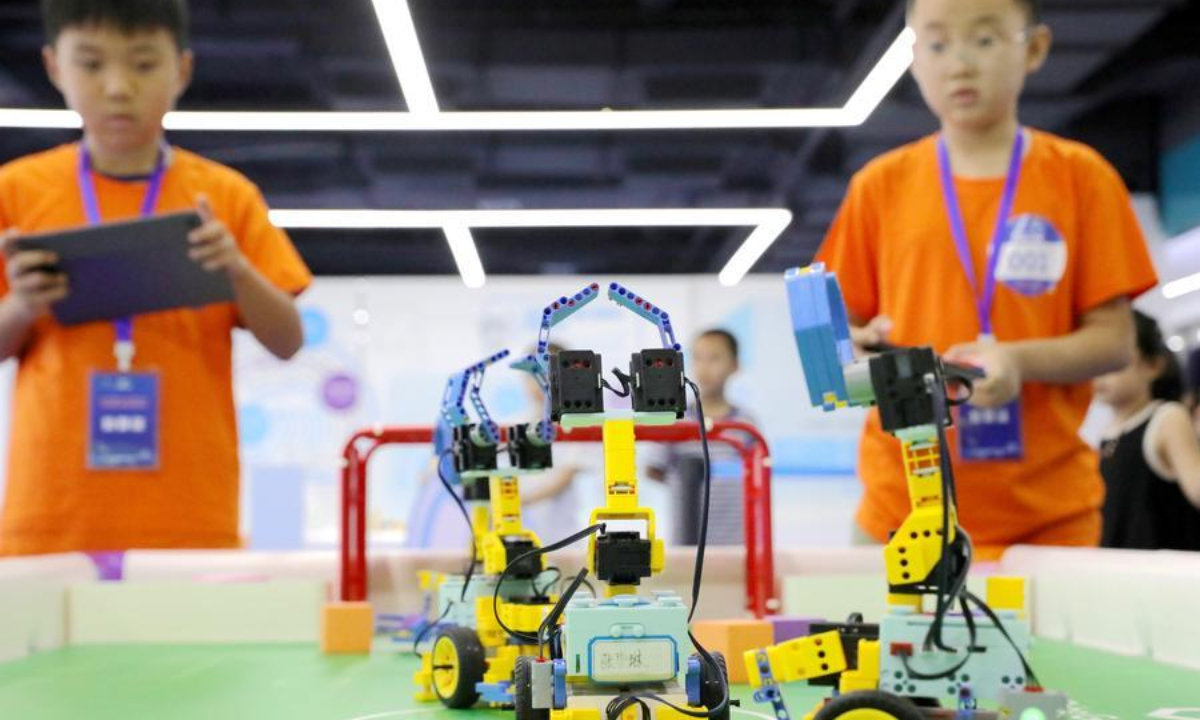
At a nearby workbench, nine-year-old Zhang Qihang was busy assembling a robot of his own. "Building robots is awesome! I can let my imagination run wild," he said, beaming with excitement.
This was the scene at an artificial intelligence (AI) summer camp -- part of a new wave of study tours gaining traction across China. Moving beyond textbooks, students are flocking to tech giants, university labs and science centers, eager to get hands-on experience with cutting-edge AI technologies and see firsthand how the future is taking shape.
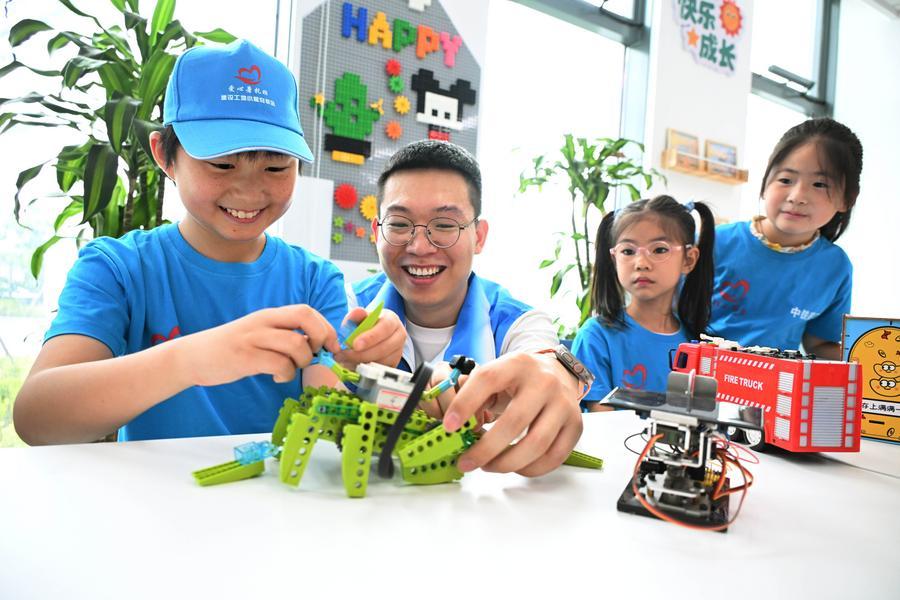
AI STUDY-TOUR BOOM
During this summer vacation, AI-themed study tours have begun to gain ground, with bookings surging 370 percent year on year, according to online travel platform Ctrip.
To tap into the growing demand for AI-focused tech tourism, a travel agency based in Nanjing, east China's Jiangsu Province, began adding visits to technology companies to its trip programs last summer. "On our Shanghai-Hangzhou independent study tours, AI-related activities now account for more than 80 percent of the itinerary," founder Zhu Ping said.
The boom is unfolding against the backdrop of China's broader AI boom, powered by a wave of homegrown models and applications. For a growing number of Chinese teenagers, AI tools such as DeepSeek, Kimi and Doubao are becoming familiar companions in their everyday lives.
The number of AI enterprises in China had surpassed 6,000 last year, and the output value of the core AI industry was projected to exceed 1.2 trillion yuan (about 177 billion U.S. dollars) during the same period, representing a year-on-year increase of nearly 30 percent.
Moreover, China was home to more than 140 humanoid robot developers in 2025, with shipments reaching 14,400 units -- accounting for 84.7 percent of the global market, according to an industry research report.
To help children prepare for an AI-driven future, China unveiled an "AI Plus Education" initiative earlier this year, encouraging schools to take AI learning beyond the classroom through after-school programs and hands-on activities. The goal is to help students understand and use AI properly, while sparking curiosity, nurturing creativity and honing their critical-thinking and problem-solving skills.
Today, the AI study-tour wave is sweeping through China's schools, as primary and secondary schools incorporate it into their educational programs. Parents are taking their children into the heart of the tech industry to see how AI transforms the real world.
China's tech-tourism boom is also drawing international visitors keen to get a close-up look at the innovation behind "Made in China."
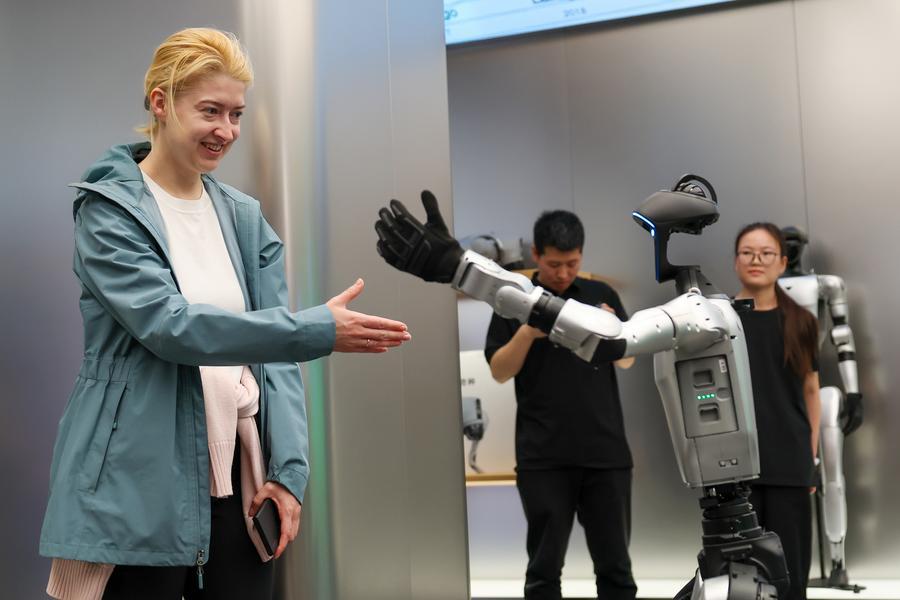
Since opening in Shanghai in May, Unitree Robotics's first embodied intelligence experience store in Asia has attracted many foreign visitors.
Victoria, from Denmark, visited the store last month. "I've seen some of the dancing videos, but it's really cool to see them in real life," she said, viewing the development of AI and robotics in China as "revolutionary, new and exciting."
FROM AI USERS TO AI CREATORS
Today's children are growing up as AI natives, already fluent in AI tools. But AI study camps are opening a new window onto how the technology is reshaping the world around them and how they can use it to make a difference.
For Liang Yiduo, a Beijing middle school student, an AI summer camp run by internet giant NetEase offered a fresh perspective on the AI technology he thought he already knew.
"I realized that large language models aren't just chatbots or simple tools," he said. "They can be assistants that work alongside you and help you create things tailored to your needs, like 'claws.'"
"The goal of the study camp is to help children move from simply using AI to understanding it, creating with it and even building their own AI agents," said Wang Lijin, director and founder of Beijing Venus Future Education Consulting Center, which assists NetEase in running its study camps.
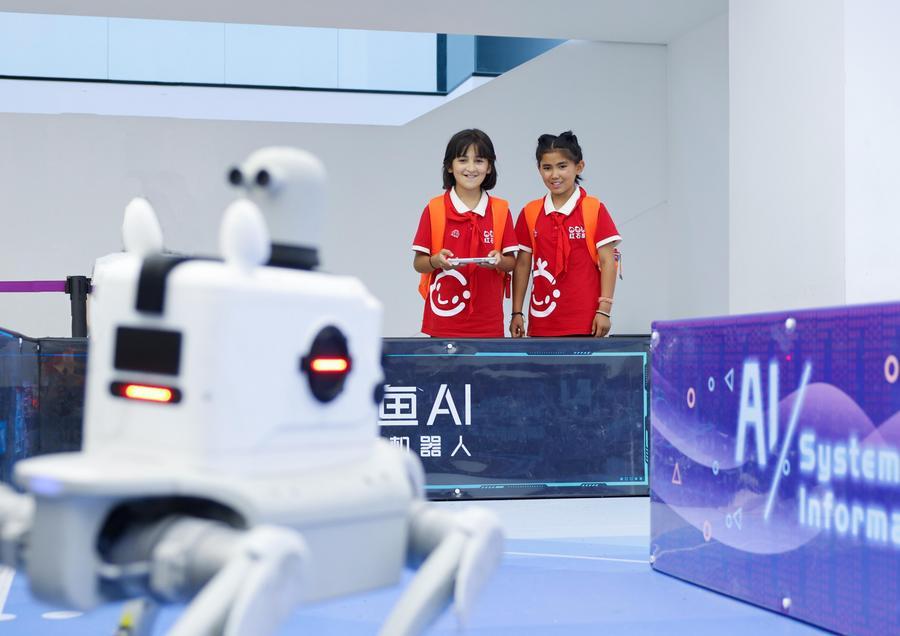
Some study tour organizers design programs around students' interests and abilities, aiming to spark curiosity and encourage deeper thinking.
Shanghai Qingbao Robot Co., Ltd., for example, offers students who enjoy building things the chance to assemble robotic arms and explore the mechanics of shoulder and neck structures. It also gives students a comparative look at the robotics and AI industries in China, the US, Europe and Japan, helping them gain a more balanced understanding of China's strengths and shortcomings.
Wang Lei, the company's chairman, believes that study tours can greatly broaden students' horizons in science and innovation. "Through immersive study tours, students start thinking for themselves about how robotics can be applied to everyday life, from unmanned retail to automated pharmacies," he said.
Some students are taking it a step further, learning to spot real-world problems and use AI to develop solutions.
In the southern Chinese city of Shenzhen, a group of students spent six days in a camp turning ideas into an AI-powered product.
"I've realized that learning AI isn't about showing off what I can do with it, but about using it to solve real problems for others," said one team member. "I want to keep learning AI so I can help more people in the future."
。

Amid a new round of Philippine hype over its so-called territorial claims involving China's Huangyan Dao, the US State Department on Saturday, in a statement, smeared China's Huangyan Dao National Nature Reserve as "destabilizing" and pledged support for its ally. A Chinese expert said Washington is encouraging Manila to disrupt regional peace while offering little more than hollow verbal assurances, further undermining stability in the South China Sea.
The statement, published on the State Department's official website and attributed to spokesperson Thomas Pigott, claimed that the US "rejects China's ongoing attempts to enforce its destabilizing 'national nature reserve'" at Huangyan Dao.
Pigott also alleged that the reserve would "deny Filipino fishermen access to their traditional fishing ground as reflected in the 2016 Arbitral Award."
It is absurd for the US, a country that is not a party to the United Nations Convention on the Law of the Sea (UNCLOS), to pass judgment on the Huangyan Dao National Nature Reserve, Yang Xiao, a research fellow at the Institute of Peaceful Development under the Chinese Academy of Social Sciences, told the Global Times on Sunday.
The US has neither jurisdiction in the South China Sea nor the standing to judge regional affairs. Its allegation of the reserve at this time is merely intended to echo the Philippines' latest hype surrounding Huangyan Dao, Yang said.
At a time when the broader China-US relationship is moving toward an easing of tensions, attempts by certain US officials to encourage provocations out of narrow political interests run counter to the overall trend, Yang said.
Pigott further smeared the reserve as "another unilateral attempt by China to use dubious environmental and legal pretexts," which he claimed was intended to advance China's territorial and maritime claims in the South China Sea "at the expense of its neighbors."
"The United States stands with our Ally, the Philippines, in support of a free and open Indo-Pacific," Pigott claimed.
The expert added that the statement also invoked the unlawful and invalid 2016 "South China Sea Arbitral Award" as a pretext, seeking to portray China as a destabilizing force in the region and mislead the international community.
The US statement comes as Manila has sought to advance its claims over Huangyan Dao through various means, including by delimitation of the so-called "baselines of the territorial sea" of the Chinese territory of Huangyan Dao. The Chinese Foreign Ministry on July 31 described the move as "illegal, null and void."
Yang said that amid a broader retrenchment of its global strategy, the US is seeking to encourage countries including Japan and the Philippines to stage regional provocations and disrupt stability. Such tactics include organizing joint military exercises and tolerating provocative actions by Manila in the South China Sea.
However, Washington is no longer capable of offering the Philippines substantive support and can provide little more than rhetorical backing, Yang said. Such statements amount to words on paper and have no practical effect, he added.
China's State Council approved the establishment of the Huangyan Dao National Nature Reserve in September 2025. China has since conducted multiple scientific surveys in the area.
On August 1, China issued management measures for the reserve, prohibiting unauthorized fishing and mining, the harvesting or excavation of corals, coral reefs and giant clams, as well as other activities that damage rare marine species or the reserve's natural ecosystems.
China has also discovered a globally rare coral reef growth structure-type marine blue hole at Huangyan Dao. Preliminary geochronological analyses suggest that the blue hole formed at least 3,200 years ago, while surveys have found rich biodiversity in its surrounding waters. The finding is considered further evidence of the effectiveness and necessity of China's ecological protection measures at Huangyan Dao.
。

二 |
Current article:http://twlm.shangfochengcongshuaizhuang.buzz/s28rn/20260826/4062.html
Published on:01:38:34
我的网站相关内容
 看见雄安丨当80后、00后分别给一座“自己会发电”的房子做视频……
 王霜留洋美国上演首秀 下半场替补登场
 最高直降250元,扫石机器人年度商品节,全网最全的采购策略
 OpenAI 将崩溃调试视为流行病学研究,修复了存在 18 年之久的 GNU libunwind 漏洞
 上半身〝ノーガード〟現役女性社長、藤渡小百合の大胆〝バックショット〟に「たまらないよ」「凄く惹き込まれてしまう」反響の声
 公务员大削减:新西兰统计局所有员工自愿裁员
- ·复星医药:上半年归母净利润17.21亿元,同比增长1.1%
- ·绿联科技:上半年归母净利润4.31亿元,同比增长56.90%
- ·Asking a PU schoolgirl to take off her hijab at her school gate, is an invasion on her privacy: Justice Dhulia
- ·“2024北京榜样”大型主题活动启动
- ·特朗普的波音飞机在佛罗里达机场滑行时与停放的飞机相撞,特朗普情况不明
- ·国乒最佳阵容国庆亮相首钢园!WTT中国大满贯2026三大升级
- ·High-tech and high-value goods power exports
- ·“为了监控猴痘,我在樟宜机场值夜班,为旅客检测体温”
我的网站最新内容
- ·北美观察丨美国8月CPI同比上涨8.3% 通胀忧虑引发美股暴跌
- ·第34届广博会吸引17万人次观展,意向合作总额超483亿元
- ·基督城恐袭五周年:受害者伤痛还在,ACC已切断补偿
- ·深圳侨商会:凝侨心汇侨力助发展
- ·普京:收到一些方案很离奇,不可接受
- ·马来西亚林吉特兑美元升至4.030,创6月初以来新高
- ·尽情去嗨,即刻出发!体彩顶呱刮申城上新
- ·实现“零”的突破!抚顺“大伙房水库鳙鱼”上榜全国名特优新农产品名录
- ·资金层面出现三个降温信号
- ·海外媒体刷屏,外星人接触地球?
- ·‘2026 version of Journey to the West’ goes viral as classic comes alive in young people’s everyday lives
- ·기모바지 샀는데 여름바지 배송···“유튜브 광고 해외쇼핑몰 주의하세요”
- ·雷军:玄戒O100未来将应用于手机、汽车、机器人等全生态品类
- ·第一夫人被立案调查,韩国政坛斗争加剧,尹锡悦麻烦不小
- ·新华鲜报丨8.2万家助餐点 守护长者幸福“食”光
- ·“一单到底”+数据联通 多式联运跑出物流加速度,“一单到底”+数据联通 多式联运跑出物流加速度
我的网站热点内容
- ·四川自贡已储备“十五五”项目1896个 总投资达1.47万亿元,四川自贡已储备“十五五”项目1896个 总投资达1.47万亿元
- ·“蝎子”被抓了
- ·破纪录的伽马射线爆发可能标志着黑洞的诞生
- ·Assam CM urges companies to invest in state
- ·Hong Kong population rises 0.3% as inflows offset natural decrease
- ·乡村文旅怎么做活?运营前置 + 文化赋魂才是破局关键
- ·印度伊朗签署港口协议数小时后,美国警告:可能制裁
- ·机械革命Z2光超笔记本预售:RTX2060版本9999元
- ·中国机器人产业“加速跑”为世界提供新机遇
- ·内塔尼亚胡声称伊朗曾企图暗杀其子;以媒报道其即使大选落败,家人仍将获国家安全总局至少5年安全保护
- ·【成长·传承】春龙抬头 “童”趣无限——青岛高新区实验幼儿园开展“二月二,龙抬头”活动
- ·纳达尔鼓励阿尔卡拉斯:希望没受伤,接下来的赛事全力以赴
- ·维尼修斯:为200胜里程碑高兴,希望书写历史成为最伟大球员之一
- ·网站数据自动备份:一个脚本+一个计划任务搞定
- ·China In Photos: Chinese archaeologists uncover 2,300-year-old grain wine, decoding its formula and brewing method
- ·WAIC 2026,凌迪科技把服装柔性仿真,摆上了具身智能的台面