
俯卧撑
박현주 “삼전닉스, 배당보다 투자해야…주주환원 요구는 허접한 얘기”_我的网站

A |
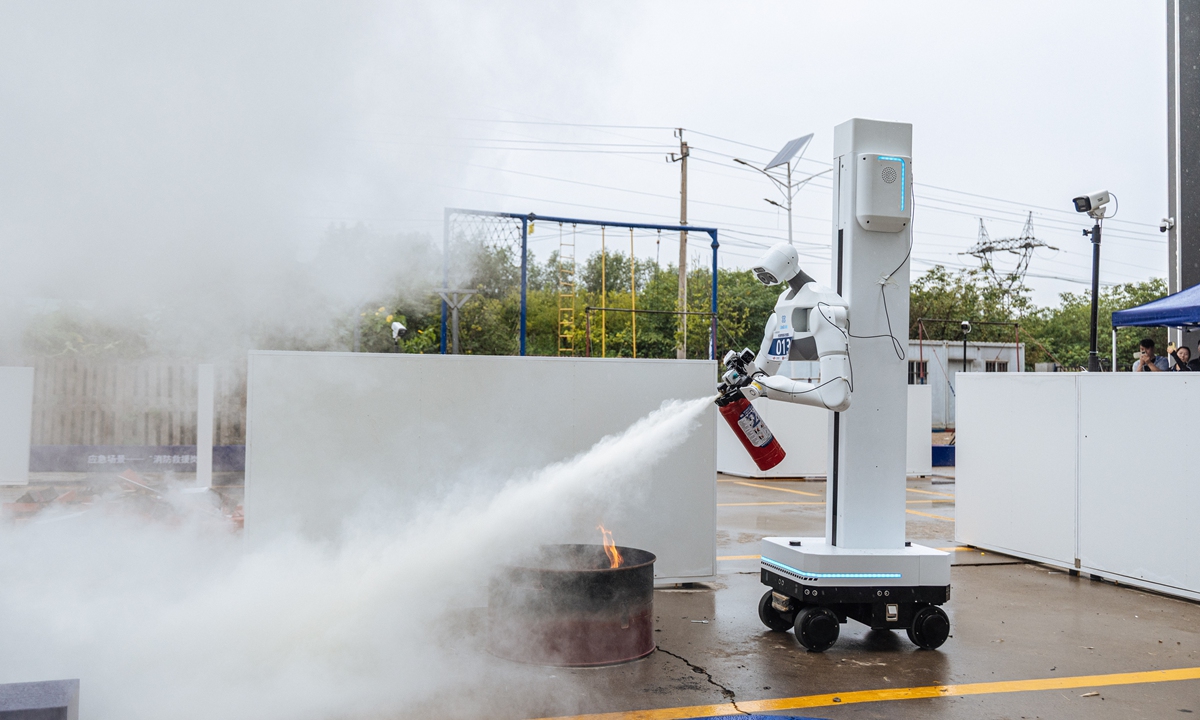
The firefighting final of the emergency management category at the 2nd World Humanoid Robot Games (WHRG) was held on Sunday in Beijing, putting 23 teams through a simulated rescue operation designed to test whether humanoid robots can move beyond demonstrations and perform practical tasks in complex real-world environments.
The event comes as Chinese humanoid robots, long known for eye-catching abilities such as running, dancing and music playing, are pushed toward practical applications, including jobs that are dangerous for humans such as emergency rescue.
Unlike the first edition of the WHRG last year, according to the organization committee, this year's scenario-based events emphasize "realistic simulation," with the firefighting competition being held at a fire brigade rather than in a model-room setup.
The competition simulated a firefighting assignment that required each of the 23 robots to complete three tasks within 30 minutes: identify hazardous materials, shut off valves and operate a fire extinguisher. For the first task, robots had to identify two randomly placed simulated hazardous substances and report their types to judges through returned images. They then had to locate three randomly selected open valves of different types and shut them off before identifying a fire source, finding a fire extinguisher and spraying it until the fire was put out.
Human firefighters were also involved in the event, lighting the fire and observing whether the robots carried out the extinguisher operation correctly.
The competition, however, showed how difficult it remains for robots to perform reliably outside controlled laboratory conditions.
Rain affected the competition, while changes in lighting and the outdoor environments added uncertainty to the robots' visual recognition and manipulation tasks. A team from UniX AI, a company well-known for its robot applications on real-world scenarios and has just raised a new round of 300 million yuan ($ 44.49 million) in late March, completed its run within the allotted time, but its robot moved relatively slowly compared to human firefighters' real practice. When operating the fire extinguisher, its robotic hand had to make two attempts to align with the target.
Of 12 teams competed on Sunday, three finished the challenge.
Yang Liqi, a representative of the UniX AI team, told the Global Times that the firefighting scenario placed higher demands on both the robot's recognition and manipulation capabilities.
"Rain and lighting conditions can affect the robot, and actual situations are often different from what we simulate in the laboratory," Yang said, noting that this was also one reason why a number of teams were unable to complete their runs on Sunday morning.
The team had programmed the robot to make up to three attempts when operating the extinguisher. "If it sees white smoke after the first attempt, it will not make a second attempt," Yang said.
The difficulty was not simply that whether the robot could move its arm. Humanoid robots rely on different types of joints for different tasks: small, high-precision joints enable delicate hand operations, while high-torque, reliable joints support movement and balance.
A failure at any point of actions and detection could affect the final result. This is precisely where the value of real-world competitions lies, Jin Chenran, a representative of the Tiangong team whose robot only accomplished one of the three tasks, told the Global Times.
"Whether the competition goes smoothly or not, that is the significance of a real-world simulation. Every real-world failure is valuable data that helps humanoid robots toward practical application," Jin said.
Jin further explained that questions like why the robot failed to recognize an object and how its motion-planning system selected the wrong path... Such data can subsequently be used to improve algorithms and train AI models.
The competition also offered a glimpse into the current transitional stage of humanoid robot technology. At the venue, some team members were wearing VR headsets and remotely adjusting their robots shortly before their runs.
Some humanoid robots were seen using omnidirectional wheels instead of feet, while their hands featured multiple joints to enable more precise manipulation. Many teams chose China-developed UBTECH's joint modules for their robots. Its servo actuators cover a wide torque range from 0.2Nm to 200Nm, allowing robots to combine dexterity with strength. Meanwhile, VR teleoperation gives operators a first-person view through the robot's cameras, enabling them to remotely guide movements in real time.
The event comes amid a broader push in China to move humanoid robots and embodied intelligence from laboratories and competition arenas into real production and daily-life environments. In June, the Ministry of Industry and Information Technology and the other departments launched a special program for humanoid robots and embodied intelligence that encouraged applications in practical fields including emergency rescue.
Zhao Weidong, deputy director of the organizing committee office, told the Global Times that the scenario-based competitions are intended to test the progress of humanoid robots from "competition performance" toward "real operational work," including whether they can eventually become intelligent partners for firefighters.
"At present, many simulations of actual operations may still be at an early stage," Zhao said. "But these are an important starting point for enabling robots to truly assist humans in real-world environments, as well as an important source of data and testing."
The ultimate goal, Zhao said, is to push robots into fields where human operations are dangerous and achieve genuine "human-robot complementarity."
。 “자본 축적해 과감히 키워야…반도체 고율관세 가능성 낮아”원화 스테이블코인엔 회의적박현주 미래에셋그룹 회장 겸 글로벌전략가(GSO)가 삼성전자와 SK하이닉스에 대한 주주환원 확대 요구를 두고 "허접한 얘기"라고 일축했다. 배당을 늘리기보다 자본을 축적해 미래 성장을 위한 투자에 나서야 한다는 취지다. 박현주 미래에셋그룹 회장 겸 글로벌전략가(GSO). 연합뉴스박 회장은 26일 서울 종로구 포시즌스호텔에서 디지털엑스 임직원들과 만나 "삼성전자가 주주환원을 못 해서 주가가 내려간다? 그런 허접한 얘기가 어디 있느냐"며 "주주환원을 해봐야 5~7%인데 그러면 미국 국채를 사는 게 낫다"고 말했다.이어 "배당을 많이 했으면 삼성전자와 SK하이닉스가 생겨났겠느냐"며 "배당을 안 해야 회사가 좋아지는 것이다. 자본 축적으로 과감히 키워야 한다"고 강조했다.미국의 대(對)한국 관세 정책에 대해서도 지나친 우려는 필요하지 않다고 봤다. 박 회장은 "미국이 한국에 관세를 세게 매기기는 어려울 것"이라며 "반도체 없이는 엔비디아도, 미국 빅테크도 돌아가지 않는다. 미국이 한국에 50% 관세를 매긴다는 건 천만의 말씀"이라고 했다.부동산과 관련해서는 "부동산 세제가 장난이 아니라고 생각한다"며 "지금 주택 문제도 해결될 가능성이 있다고 본다"고 평가했다. 이어 "부동산으로 돈 버는 시대는 모두를 위해 끝나야 한다"며 그래야 젊은 세대가 복지를 체감할 수 있다고 말했다.한편 원화 스테이블코인의 성장 가능성에는 회의적인 시각을 보였다. 박 회장은 "달러 스테이블코인은 달러 수요 때문에 갖고 있을 수 있겠지만 원화 스테이블코인이 굉장히 잘될지는 의문"이라고 말했다. 구글 등 글로벌 빅테크가 블록체인 결제시장에 뛰어들고, 향후 증권사 역시 인공지능(AI)을 활용한 자동 자산관리 서비스를 제공하게 될 것으로 전망했다.가상자산 투자에 대해서도 경계했다. 그는 "비트코인으로 돈 번 사람이 거의 없다. 거의 패가망신 수준"이라며 대출까지 받아 투자하는 방식은 위험하다고 지적했다. 그러면서 "코인을 좋아하는 고객들에게는 10분의 1 정도만 하라고 하고, 다른 투자로도 수익을 낼 수 있다는 것을 보여주겠다"고 말했다.도널드 트럼프 미국 대통령의 친(親)가상자산 행보도 비판했다. 박 회장은 정치권이 특정 자산에 직접 개입하는 것은 "굉장히 위험한 일"이라며 트럼프 일가의 가상자산 사업과 업계 관계자들과의 밀착 행보를 문제 삼았다.。
Current article:http://twlm.shangfochengcongshuaizhuang.buzz/364w/20260826/9009.html
Published on:19:06:47